
Value is perceived, not produced.
It is an emergence.
The definitive blueprint for the next century of value creation — VAKR, the world's first technology-independent, domain-independent framework for designing value systems. Don't measure value. Architect the conditions in which it emerges.

Five stages. One reflexive loop.
Value is not intrinsic to objects — it emerges from the interaction of Context, Perception, Action and Outcome. The PARVO cycle — Perception, Action, Result, Value, Observation — turns that interaction into a measurable, repeating loop. Select a stage to inspect its foundation.
The Epistemological Stage
Value is perceived, not produced. W_perception — the normalized stakeholder perception metric (0.0–1.0) — determines whether value is seen at all. The 0.448 threshold is the cognitive tipping point; below it, interventions actively harm.
Grounded in Chapter 01's challenge to Aristotle's intrinsic/instrumental value dichotomy — and in Korzybski's general semantics — the cycle follows a systems-first methodology: measure the loop, not the parts.
Metrics. Patterns. Layers.
VAKR is not metaphor — every construct carries an operational measurement. Four key metrics score the loop, four canonical value emergence patterns describe how value emerges, and a layered architecture keeps the framework independent of any technology or domain.
04 Key Metrics
Scored, not asserted04 Canonical Patterns
Value Emergence · P-VEThe Layered Architecture
VAKR describes the structure of value itself — not the tools used to chase it.
Abstraction across ontology, metric, pattern and method lets the framework transfer across sectors unchanged in principle.
The protocol for moving a pattern between domains without losing fidelity.
Illustrated across complex systems.
20 hypothetical scenarios (IA-001–IA-020) across eight sectors, plus 5 retrospective case analyses. Illustrative by design — the framework, not the anecdotes, carries the claim.

Context Collapse — CC < 0.3, failed P-VE-002.
Ignored the perceptual shift; Wₚ fell 0.8 → 0.2.
Innovator's Dilemma — ESS < 0.4.
Ethical Scalability collapsed below the 0.8 floor.
Cross-Domain Synthesis — P-VE-004.
Sustained Wₚ > 0.85 across 27 years.
Evidence-Driven Refinement — P-VE-003.
Continuous ΔWₚ measurement; 95%+ fidelity.
Contextual Adaptation — P-VE-002.
CC management across radical context shifts.
What you will discover.
The Foundations of Value
A new ontology for understanding value beyond outputs and profit — value as emergence, not artifact.
The PARVO Cycle
Perception, Action, Result, Value, Observation — a reflexive loop grounded in Korzybski's general semantics and a systems-first methodology.
The VAKR Framework
A simple yet powerful model to design, align and govern value systems across people, organisations and technology.
Patterns & Practices
Four canonical value emergence patterns (P-VE-001–004), six practices and five methods, with practical guidance for real-world application.
People. Organisations. Technology.
How the right alignment of context, perception, action and outcome creates extraordinary, sustained impact.
A Discipline for the Future
Build organisations that adapt, evolve and create value — sustainably, across cycles of continuous refinement.
Value Architecture is more than a framework. It is a new way of thinking. It gives leaders, architects and change-makers a shared language and a practical compass to navigate complexity and design a better future.
Acquire the blueprint.
The book is available in E-book and Paperback editions on Amazon. Order your copy and receive the knowledge modules that operationalize the framework.
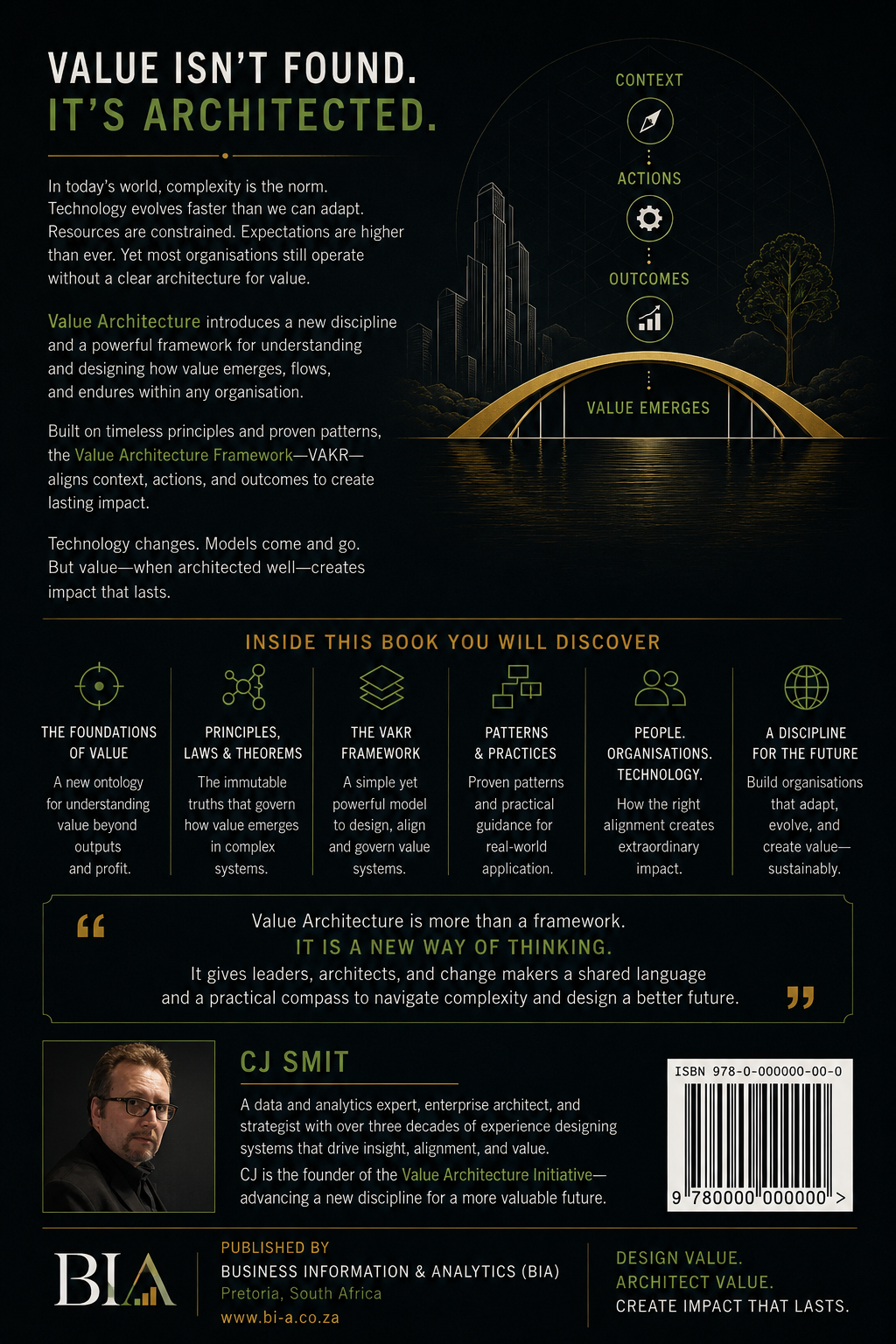
Back-cover insights, decoded.
Each module maps a core theorem of the framework to its practical consequence. Expand to inspect the underlying law.
Separation of Value Logic, Implementation and Measurement layers keeps the framework independent of any stack; abstraction across ontology, metric, pattern and method makes it independent of any domain.
W_perception ≥ 0.448 is the cognitive tipping point. Below it, interventions actively harm. The metric is diagnostic — gaming it destroys the very value it measures.
Effectiveness depends on adaptation proportional to context divergence. Patterns transfer only when modified to match the receiving context — scored, not assumed.
21-day routines embed value practices, retaining 89% of gains over six months. Without institutionalization, value decay is predictable and inevitable.
Combining frameworks through complementary patterns yields an emergent bonus of 30% or more — super-additive value that exceeds the sum of individual contributions.
Choose your edition
- E-book and Paperback editions, fulfilled by Amazon
- Digital companion: the VAKR pattern library
- Access to the Value Architecture Initiative community
Orders, payment and delivery are handled by Amazon. Pricing is shown on each edition's Amazon listing.